Black Maiden (The Caged Bird Sings a Soliloquy of Midnight Veil)
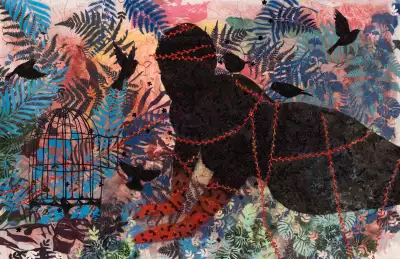
MOREL DOUCET, Black Maiden (The Caged Bird Sings a Soliloquy of Midnight Veil), 2022, Mix-media (acrylic and ink on paper with glitter, spray paint, watercolor paper, oil pastels, and fabric), 52 × 80 in
Black Maiden (The Caged Bird Sings a Soliloquy of Midnight Veil) intricately aligns with the theme of Nou Ayiti, drawing on the resilience, struggle, and triumph embedded in Haitian identity and its diasporic legacy. The work echoes Haiti’s revolutionary spirit and its enduring pursuit of freedom, autonomy, and justice—principles that have shaped the nation’s past and continue to define its present.
Through the lens of modern Black womanhood, the piece parallels Haiti’s long-standing resistance against systemic oppression and neglect, mirroring the collective strength and perseverance of its people. The bound and hunched figure of the Black Maiden embodies the weight borne by those who have been marginalized and silenced—much like Haiti’s own position within the global imagination. Red vines wrap the figure in quiet tension, symbolizing both the constraints of oppression and the unseen struggles carried by Black communities, particularly Haitian women, who often serve as pillars of resilience.
Surrounding the figure, free birds sing and dance in remembrance. Their presence evokes Haiti’s cultural vibrancy and its revolutionary legacy as the world’s first free Black republic—an enduring symbol of liberation and defiance. The birds’ song becomes a metaphorical call to reclaim identity, restore agency, and imagine new futures—a call that lies at the heart of Nou Ayiti.
By engaging themes of freedom, memory, and rebirth, Black Maiden becomes a meditation on what it means to rise from inherited wounds and reclaim selfhood. It honors Haiti’s revolutionary past while asserting the need for continued transformation. Through its rich symbolism and diasporic lens, the work captures the emotional, cultural, and political complexity of Haiti—embodying the spirit of Nou Ayiti and its vision for a more liberated and just future.

The Brown Menagerie
MOREL DOUCET, The Brown Menagerie, 2015, Glaze ceramic, aerosol paint, 10 × 6 × 15 in
The Brown Menagerie aligns deeply with the themes of Nou Ayiti, interrogating the complex intersections of identity, race, and beauty through an Afro-Caribbean lens, while reflecting on Haiti’s historical and cultural context. The color brown, central to the work, represents the richness of soil—a symbol of life, nourishment, and the land that sustains Haiti. At the same time, brown becomes a metaphor for marginalized identities, often overlooked or dismissed. This is reflected in studies like the crayon box experiment, where children consistently avoided the brown crayon, revealing internalized biases around race and beauty.
This piece challenges such perceptions by reclaiming brown as a symbol of resilience, power, and cultural pride. The Afro-Caribbean framework of The Brown Menagerie mirrors Haiti’s ongoing assertion of its identity and humanity in a world that has historically sought to diminish both. The reference to soil further evokes Haiti’s legacy as the first free Black republic—its revolutionary past and its enduring relationship to the land, which has been both a site of struggle and a source of sustenance.
By weaving together themes of race, sexism, and fashion, the work critiques societal norms that uphold colorism and Eurocentric beauty standards—forces that have deeply impacted Haiti and its diaspora. The deliberate focus on brown skin, brown eyes, and brown hair serves as an assertion of inherent beauty and dignity within the Afro-Caribbean community. It urges viewers to reconsider dominant narratives and to reimagine what brown symbolizes.
Through this exploration, The Brown Menagerie contributes powerfully to the vision of Nou Ayiti—celebrating the strength, complexity, and vibrancy of Haiti and its people. It invites reflection on the cultural and historical weight carried by this often-dismissed color and emphasizes the urgent need for representation and reclamation within Haiti’s imagined future—one rooted in equity, beauty, and belonging.
Skin Congregate on Every Mountain
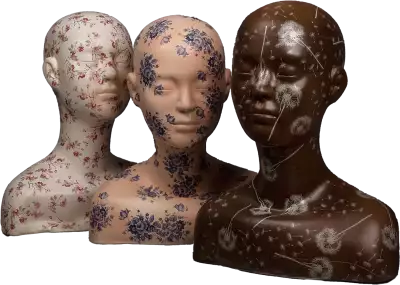
MOREL DOUCET, Skin Congregate on Every Mountain, 2019, Slip-cast porcelain ceramics
Skin Congregate on Every Mountain embodies the central themes of Nou Ayiti by examining the intersections of identity, mobility, and survival within the Afro-Caribbean experience, while also addressing broader global issues of displacement and privilege. Through intricate floral symbolism, the work reflects on the sociopolitical dynamics of colorism and class, anchoring these themes within Haiti’s history and its people’s ongoing struggle for self-determination and equity.
The brown ceramic bust, representing both resilience and fragility, evokes the lived realities of Black and brown communities. It draws a direct line to the displacement caused by climate gentrification and urban development—communities uprooted by forces beyond their control, much like the dandelion carried by the wind. This metaphor mirrors the historical and ongoing challenges of survival, migration, and mobility faced by Haitians and the wider African diaspora.
Colbert blue flowers, traditionally associated with class and privilege, critique the exclusivity of wealth and access historically denied to Haiti and its people. Once a color reserved for royalty and elite circles, blue here becomes a stark contrast—underscoring the inequities built into global systems of economic extraction, where the labor and suffering of the many uphold the luxury of the few.
Cherry blossoms, symbols of transience and shared beauty, suggest both the fragility of progress and the enduring potential for renewal. In the Haitian context, they speak to the fleeting nature of societal gains amid ongoing structural oppression, while also offering a sense of interconnectedness and hope across communities of color.
Through its layered materials and narrative, Skin Congregate on Every Mountain aligns with the ethos of Nou Ayiti—reimagining Haiti’s future through a lens of environmental justice, cultural resilience, and collective memory. It invites reflection on the systemic forces shaping our world, while honoring the strength and beauty of those who continue to resist, rebuild, and dream
The Hills We Die On (Flowers for President Jovenel Moïse)
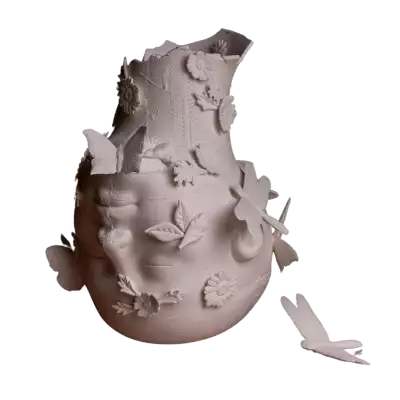
MOREL DOUCET, The Hills We Die On (Flowers for President Jovenel Moïse), 2021, Slip-cast porcelain ceramics
The Hills We Die On (Flowers for President Jovenel Moïse) powerfully aligns with the themes of Nou Ayiti by engaging with Haiti’s political and historical complexities while honoring its enduring spirit of resilience and transformation. Through layered symbolism, the piece commemorates the life and legacy of President Jovenel Moïse—a leader whose humble beginnings reflected the lived experiences of the Haitian people. His connection to the land and his vision for national progress serve as a central thread, reminding viewers of Haiti’s deep agrarian roots and its ongoing struggle for autonomy and prosperity.
The upside-down emoji face, rendered with irony and passive aggression, speaks to the contradictions of Haitian politics—where hope and disillusionment often coexist. This element underscores the tensions faced by both leaders and citizens as they navigate entrenched systems of power, while also invoking the globalized, digital language through which Haiti’s story continues to unfold on the world stage.
Butterflies gracing the figure’s face symbolize transformation and possibility, offering a vision of Haiti rising above hardship to reclaim its narrative with grace and power. The stark white porcelain head gestures to the artist’s familial ties to Haiti’s agricultural traditions, with a quiet nod to the daily ritual of coffee—a symbol of labor, endurance, and introspection.
Blending personal history with collective memory, The Hills We Die On honors President Moïse’s vision while offering a poignant meditation on Haiti’s past, present, and future. The work captures the spirit of Nou Ayiti by bridging grief with hope, critique with reverence, and commemoration with imagination—reaffirming art’s power to envision a more just and self-determined Haiti.
My artistic practice deeply aligns with the themes of Nou Ayiti, exploring Haiti’s past, present, and future through a lens rooted in resilience, identity, and cultural preservation. As a Haitian immigrant, my work embodies the essence of transnational identity—reflecting the narratives of my people through symbolic figures, whimsical forms, and a personal mythology that bridges the individual and collective experience of the Haitian diaspora.
Through ceramics, illustration, and printmaking, I explore the realities of migration, displacement, and cultural fragility, while also engaging global environmental concerns such as sea-level rise and climate gentrification—issues that profoundly impact Haiti and its diaspora. My work draws attention to the intersection of environmental decay and economic inequity, echoing Haiti’s struggle for sovereignty amid a legacy of colonialism and systemic neglect.
Haiti’s revolutionary spirit is a constant source of inspiration in my creative process. I weave my Afro-Caribbean heritage with representations of flora and fauna, evoking the deep connection between Haitian culture and nature as a spiritual and ancestral force. My work celebrates the vibrancy and endurance of Haitian identity while fostering critical dialogue around the urgent need for environmental justice and cultural continuity.
Through my practice, I envision a future for Haiti grounded in self-realization, cultural pride, and innovation. By revisiting indigenous traditions and honoring diasporic narratives, I aim to offer a hopeful testament to Haiti’s enduring spirit—and its capacity to lead, inspire, and reimagine what is possible on a global scale.
Morel Doucet (b.1990, Port-au-Prince, Haiti; lives in Miami, Florida) is a multidisciplinary artist and educator whose work spans ceramics, illustration, and printmaking. His practice examines climate gentrification, migration, and displacement within African diaspora communities, using whimsical yet incisive forms to interrogate environmental decay, economic inequity, and racialized labor.
Doucet’s work has been featured in Vogue Mexico, The New York Times, Oxford University Press, Hyperallergic, PBS, WhiteHot Magazine, Hypebeast, and Ebony Magazine. He holds a BFA in Ceramics from the Maryland Institute College of Art and is the recipient of numerous awards, including the 2024 Harpo Foundation Visual Artist Award, the 2024 Miami-Dade Individual Artist Grant, and the 2021 Oolite Arts Ellies Creator Award.
His work is included in the collections of the Pérez Art Museum Miami, the Museum of Contemporary Art North Miami, Microsoft, Facebook, and Royal Caribbean. Doucet has exhibited at institutions including the African American Museum in Philadelphia, the Museum of the African Diaspora in San Francisco, the Venice Biennale, and the Havana Biennial. His practice bridges cultural storytelling and environmental advocacy, sparking critical dialogue and collective awareness.