Forbidden Fruit
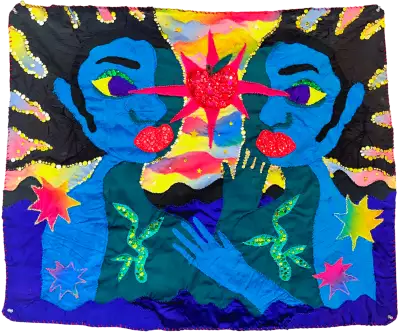
MITHSUCA BERRY, Forbidden Fruit, 2024, Hand-sewn quilt tapestry of recycled fabric
Forbidden Fruit draws inspiration from the Haitian spirits Ayida Weddo and Damballah, reimagining the story of creation through a queer lens. What if masculinity and femininity existed within us all—and both were essential to accessing full wisdom? The freedom that comes from embracing the entire spectrum of one’s humanity is often deemed taboo. This is because many have never granted themselves the vulnerability of such authenticity, and instead, meet that exploration with fear. Queerness has revealed to me the vastness of my being beyond societal expectations, leading me to an inner strength that cannot be replaced.
Speak To My Soul
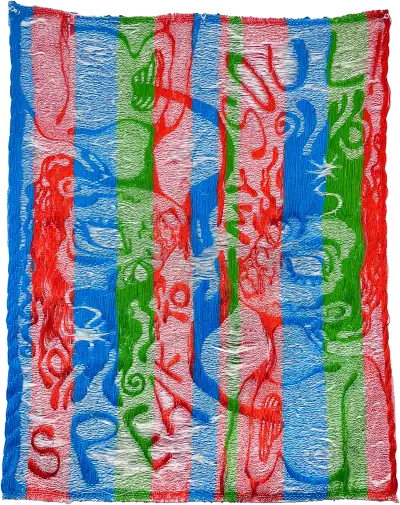
MITHSUCA BERRY, Speak To My Soul, 2024, Hand-sewn quilt tapestry of recycled fabric
With Speak to My Soul, I call to all those who speak from the heart. Fear has twisted many of our voices into a pit at the bottom of our stomachs. We’ve been told—explicitly or implicitly—that we are not worthy of hearing our own voices ring in our mouths, let alone in a room. I believe this is one of the greatest reasons so many of us struggle to speak up for ourselves and for those around us.
To express oneself is to risk being seen. And visibility has so often been met with judgment, alienation, and harm. In response, many of us have learned to shrink, to silence, to protect. But in doing so, we’ve lost touch with the power of speaking our truths—out loud.
Viv Ayiti
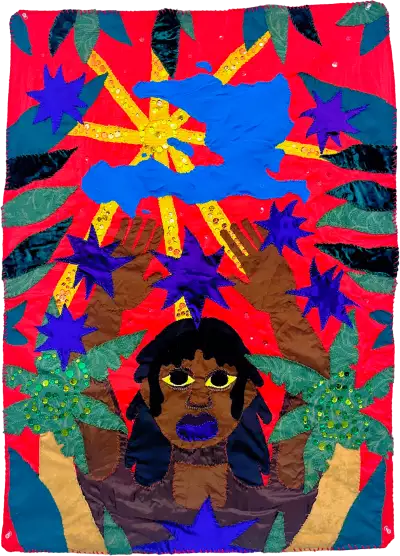
MITHSUCA BERRY, Viv Ayiti, 2024, Hand-sewn quilt tapestry of recycled fabric
Viv Ayiti is an homage to the way the island calls to my spirit. No matter where I am, I feel the shifts that take place in our country—my grief, my joy, my resistance all seem to move in rhythm with it, even from afar. I crave its warmth. My feet remember the feeling of soil between my toes. Its songs still hum me to sleep when I’m most vulnerable.
The love I feel for Ayiti is unconditional. Viv Ayiti carries that love—stitched with memory, longing, and the promise that no distance can sever my connection to home.
In a world that conditions us to abandon our souls in the name of productivity and societal acceptance, people of marginalized identities like mine are inherently alienated from the validation these systems offer. How does one see their value in an environment built to deny it? My work exists to create language for that value. I make art that celebrates all that Black queer people have ever felt, learned, and created. It serves as a space of acknowledgment—for the lives we’ve lived and the lessons learned through navigating a world not built for us. In this work, pain is not absent. Rather, it becomes something we release, making space instead for rest.
My characters roam freely—bare, grounded, always in communion with the land. They often appear as vessels, bringing new life: budding flowers, wise trees. Society imagines futures without nature the same way it imagines a future without Black people. In my universe, they are inseparable companions, making loneliness impossible. That’s why botanical imagery recurs throughout my work. It’s also why I work heavily with found and scrap materials: to reclaim what is overlooked, to honor the earth by reducing waste, and to train my mind to recognize beauty and potential in all things. I blend mediums to create pieces that stand as beings of their own—undefinable, like those of us who live at the intersection of multiple identities. My landscapes are vivid and flamboyant, echoing my queerness and Caribbean heritage. This body of work is an homage to every part of who I am, carving out a specific place in the world where I—and those like me—belong.
I am blessed to walk this earth as someone of Haitian descent. This work honors the mystical and whimsical aspects of Haiti’s history and calls upon our ancestral relationship with the land. Our revolution was not only physical—it was spiritual. We've long had a sacred relationship with the divine, and we gave that divinity back to the earth, to our loved ones, and to our collective. As colonization continues to distort that exchange, it’s crucial we remember what once freed us—because we will declare liberation again, and again. That ongoing process is the foundation of how I move through the world. I demand to be heard, seen, and respected—and I fight for everyone’s right to experience the same.
My Haitian identity co-creates alongside my gender expression, my queerness, and my love of the earth. My life is inherently one of a kind, and that is because of my ancestors. My goal as an artist is to record that experience and share it with all who resonate. In a time when Haiti is healing, we must become the inspiration it draws from to be reborn.
Mithsuca Berry (b. 2000, Laval, Québec; lives in Philadelphia, Pennsylvania) is a Haitian multidisciplinary artist, educator, and storyteller. Through their practice, they’ve redefined what creating art means to them. Each piece marks an epiphany in their journey of healing—particularly as it relates to living as a Black queer/non-binary person of Caribbean descent. For Berry, art exists at the intersection of their inner child and spiritual self, responding to the question: How do I create an archive of imagery that records the complex emotions surfacing throughout my lifetime—especially when stories like mine are so often erased?
Their intention is to sketch, write, and release those stories into the world so that others who resonate can find connection—and perhaps, healing. Their work exists to protect the future autonomy of people like them.