
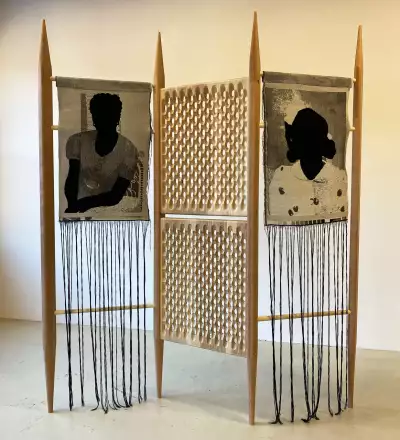
Tante Rose & Wilnie
MICHAËLLE SERGILE, Tante Rose & Wilnie, 2024, Cherry wood, ash wood, jacquard weavings, cotton
With Tante Rose & Wilnie, I continue to explore the architecture and furniture that connect my childhood home of Haiti to my adopted home in Quebec. The installation brings together two portraits—of my mother and great-aunt—integrated into a screen-like structure. This design evokes not only the backdrops used in Haitian photo studios, but also the furniture and walls found in the homes of these two women, who are/were pillars of my family.
My work aims to understand and rewrite the history of Black communities, more specifically of women or communities living in diverse intersections, through weaving.
Often perceived as a medium of craftsmanship and categorized as feminine, I use the lexicon of weaving to question the relationships of gender and race.
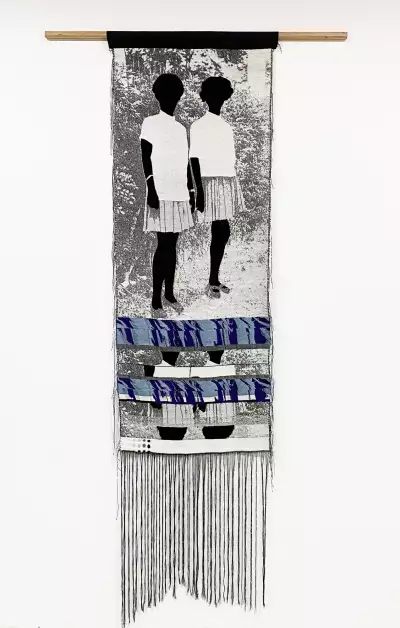
Zanmi
MICHAËLLE SERGILE, Zanmi, 2024, Jacquard weavings, cotton, hand-made cherry wood dowel
Zanmi centers on archival family images from my parents’ generation in Haiti. Reflecting on cultural identity and memory, the darkness of these intensely opaque bodies resembles an abyss—not to obscure their identities, but to evoke the vastness of their stories and the layered depths of memory they carry.
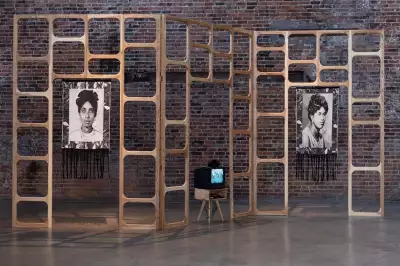
Lè m sot Ayiti
MICHAËLLE SERGILE, Lè m sot Ayiti, 2024, Ash wood, jacquard weavings, cotton, cathode TV
Lè m sot Ayiti reflects on the limits of reconstruction in the aftermath of migration. The installation features wooden walls that recall both the furniture and architectural terraces found across Caribbean landscapes. These self-supporting structures, drawn from personal memory, evoke the precarious and shifting nature of rebuilding a sense of home after leaving one’s homeland. Suspended from the wooden frame are two woven portraits, representing the first women in my family to migrate to Canada. This work also marks my first foray into a larger practice of combining wood and textiles in immersive installation.
Michaëlle Sergile (b. 1995, Chicago, Illinois; lives in Montréal, Québec) is an artist and independent curator whose practice focuses on archival texts and works from the postcolonial period, spanning from 1950 to the present. Her work seeks to understand and reframe the histories of Black communities—particularly women and individuals living at various intersections of identity—through the medium of weaving. Often categorized as a feminine craft, Sergile uses the visual language of weaving to interrogate constructions of gender and race.
Her work has been exhibited at the Musée national des beaux-arts du Québec, the Musée d’art de Joliette, and the Off Biennale de Dakar. In 2022, she was shortlisted for the prestigious Sobey Art Award. In 2023, she was named Visual Artist of the Year at the Gala Dynastie and began a residency at the Darling Foundry. In 2024, she exhibited at the Art Museum at the University of Toronto and the McCord Stewart Museum. In 2025, she will begin residencies at the Lottozero Centre (Italy) and the Icelandic Textile Centre, and will exhibit at the Centre Culturel Canadien de Paris.