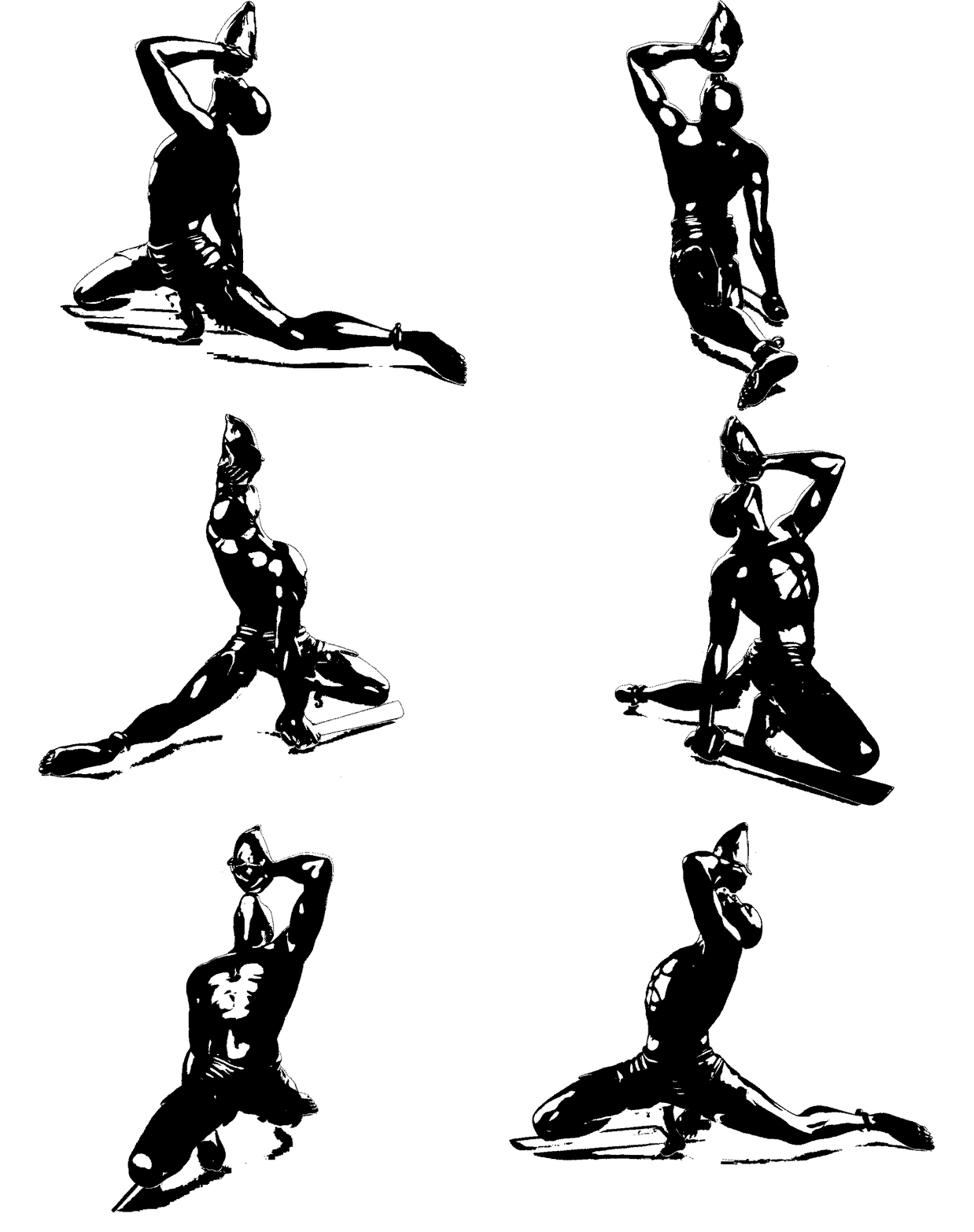
a familial anamnesis of disaster and other deathward moving things
GALA PRUDENT, a familial anamnesis of disaster and other deathward moving things, 2020, Single-channel video
a familial anamnesis of disaster and other deathward moving things stretches the definition of the environmental documentary through the poetic use of original footage, public archives, and family archives. The film asks: how does our environment manifest in our subjectivities, social universes, and personal histories? How might we reconsider the crisis of the climate in the context of these points of contact with of our global environment?
The film draws from theories like Christina Sharpe’s notion of “The Weather,” which “[expands] the meteorological notion of weather to consider the socio-economic, political, and cultural climates tethered to the histories of (neo-)colonialism,” (Nastia Volynova, e-flux).
“anamnesis…” describes the conditions of racial subjectivity, epigenetic trauma, and social biology through the terms of the “natural disaster” — represented through the hurricane, the flood, genocide, and cancer — and considers its aftermaths. A short film without speech, “anamnesis” also asks how images can serve as language — and how they serve as accessible witnesses to the changing terms of the world.
From Choir to Chasm in Three Acts
GALA PRUDENT, From Choir to Chasm in Three Acts, 2022, Single-channel video
From Choir to Chasm in Three Acts uses archival footage and found images to navigate three universes of black conceptual tradition: the choir and its aesthetics, collective ritualism, and the abstract space of a chasm or void. Collectivity and perseverance are subliminal themes in this work: it acts as an invitation to recall and imagine the mysterious and resonant power of the voice, the body, and the unseeable.

I'm moved and motivated by the work of poets and post-humanist writers, who can both transform and reimagine entrenched systems to offer something beyond their design. For poets, it's breaking apart a linguistic system (characters, terms, syntax) to produce inventions and interventions, strings of words and punctuation that refuse to adhere to the standard—offering, in turn, a lens. For writers and thinkers exploring the post-humanist zone (reading suggestion: Chapter "Horse" in Being Property Once Myself by Joshua Bennett), it's pulling apart the construction of humanity, the collective human system, with the bold hope to concoct a system that functions differently; to propose a method of collective living.
In Nou Ayiti's mission statement, I recognize the invitation to adopt a Vizyon Renouvle (renewed vision). The legacy of Haiti is both poetic and actively post-humanist. From language, poets pull invention. From the entrenched hierarchies of humanity, writers pull oppositional proposals. From the devastating circumstances of violent colonial rule and hierarchies of enslavement, the revolution imagined and enacted a different system. The revolutionaries birthed a new class; that new class birthed a diaspora. Nou Ayiti reminds me that from the ongoing heartbreak of Haiti's political reality and its environmental circumstances—ghosts of that violent colonialism—we too can imagine and enact a different future.
Nou Ayiti is a reminder that comes at the perfect time as we observe the curtain rapidly falling away from the face of American xenophobia. Nou Ayiti reminds me that my responsibility as an artist and a member of the Haitian diaspora is to hold tightly onto the agency I possess over my vision of my reality and the capacities of the future. I would like to remember that different methods of being are possible: those methods deserve our collective attention. The history of Haiti proves that those imagined realities can and should be made real.
Gala Prudent (b. 1999, Brooklyn, New York; lives in Brooklyn, New York) works across photographic processes, sculpture, and writing to propose and invent refreshed methods of relation between who we consider to be subjects and what we consider to be objects. Informed by philosophy, semiotic analysis, and an expansive canon of Black media and theory, Prudent uses photographic and dimensional materials to interrogate the flattening of social and historical subjects into instruments for social stratification and tools toward a collective architecture of humanity. Extending frameworks devised by poets and post-humanist writers alike, Prudent suggests that the distinct social categories of subject and object can function as conceptual and mnemonic kin. She understands objectification, which links a variety of marginalized subjects to thing-like perception and use, as inevitable — but imagines in response that objects possess an unrecognized capacity for memory, power, and agency.
Prudent earned her BA in Modern Culture and Media and Visual Art from Brown University and studied Art at The Cooper Union.