These Walls Will Talk
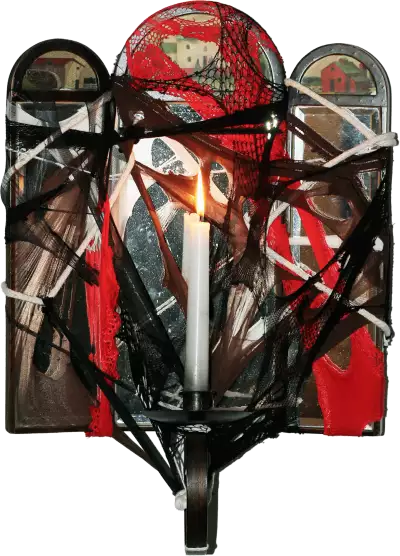
GABRIELLE NARCISSE, These Walls Will Talk, 2024, Mirror, candle, hosiery, underwear, rope
By reclaiming my narrative through my artistry, I turn my moments of darkness into sources of strength. My work is difficult as it directly confronts my history.
Still, it ultimately functions not only as an act of personal healing but also as an offering of connection to others attempting to navigate their inner torments.
My practice transforms personal trauma into pathways for reflection and healing. Rooted in my lived experiences and informed by complex struggles with trauma and mental health, my work explores themes of self-perception, identity, survival, and resilience.
My current practice incorporates antique mirrors as sculptural bases—weaving materials like undergarments, hosiery, rope, and wire into intricate forms. The use of mirrors invites viewers to confront their own reflections through the webbing that alters their perception of themselves, bridging her own narrative with the audience’s introspection. This participatory element challenges perceptions of selfhood and unveils the often unspoken struggles and histories we carry.
By reclaiming my narrative through my artistry, I turn my moments of darkness into sources of strength. My work is difficult as it directly confronts my history. Still, it ultimately functions not only as an act of personal healing but also as an offering of connection to others attempting to navigate their inner torments.
In connection with the Nou Ayiti exhibition, I draw much of my resilience from my Haitian ancestry and identity. The trauma I have endured does not exist in isolation; I have learned it is intrinsically linked to intergenerational trauma. My lineage has passed down the traits of survival, resilience, and hard work, alongside the lingering reverberations of suffering that manifest in the mind and body.
My work, These Walls Will Talk, examines how trauma can become confined within physical spaces—whether in the walls of our homes, others’ homes, or various sites of experience. Trauma may linger and breathe within these spaces, whether tied to a recurring experience or a solitary incident. Spaces that once offered comfort and safety can become infected by trauma, its presence spreading throughout.
As the daughter of a Haitian immigrant who has never visited Haiti and has been discouraged from doing so, I also navigate personal feelings of displacement in spaces that should feel like “home” and further reflect on how common the notion of home changes for Haitians. My piece invites viewers to reflect on what truly defines a home, what makes a place safe, or what makes this country, America, a home. It challenges us to question the essence of home, the complexities of displacement and safety, and how our memories—both nurturing and painful—reside in physical places.
Gabrielle Narcisse (b. 2001, Montclair, New Jersey; lives in Brooklyn, New York) is an artist, curator, and producer from New Jersey. A lifelong creator, Narcisse began drawing as soon as she could hold a marker, took her first dance classes at three years old, and started capturing photos after being gifted her first camera at six. She is a multidisciplinary artist working across sculpture, painting, performance art, dance, writing, video, and photography. In addition to her personal practice, Narcisse works as an art curator, event producer, and photo/video producer, primarily through the organization she founded and directs: Black Girl Fight Club, a community-centered initiative dedicated to empowering Black women, femmes, and non-binary people by fostering joy, connection, and creative space.
In 2024, Narcisse and Black Girl Fight Club were recognized on the Dazed 100 (US) list, celebrating the next generation of cultural innovators shaping youth culture across art, community, and creative practice.