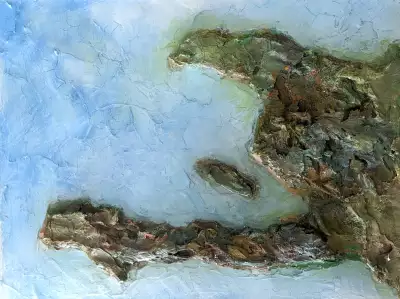
The Land
FRANTZ LEXY, The Land, 2021, Acrylic and mixed media on wood panel, 30 × 24 in
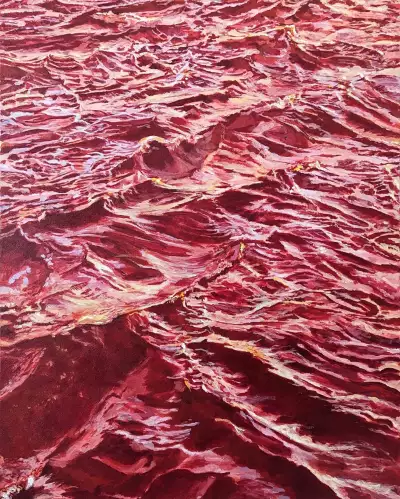
Baptism
FRANTZ LEXY, Baptism, 2023, Acrylic on canvas, 30 × 24 in
Baptism reflects the profound impact of the ocean on migration. Whether through voluntary or forced movement, the ocean has always played a central role in separating, connecting, and transporting people across the globe. It is both the first ally and the first obstacle one encounters when crossing from one landmass to another.
The ocean can be both calming and violent, embodying a duality that mirrors our complex relationship with religion—particularly Christianity. On one hand, religion offers comfort, healing, and hope; on the other, it has often been wielded as a tool of colonization, a Trojan horse used to impose "civilizing" missions that sought to indoctrinate and subjugate entire populations.
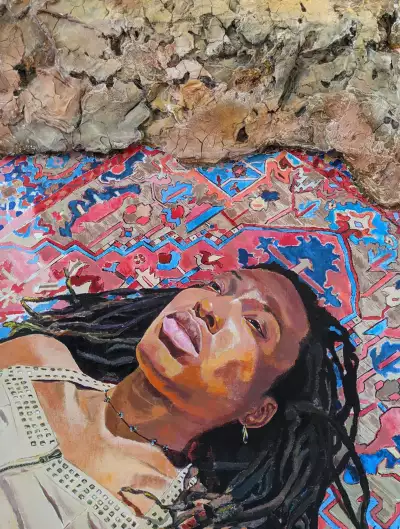
Any Time Now
FRANTZ LEXY, Any Time Now, 2020, Acrylic and mixed media on wood panel, 24 × 18 in
Any Time Now lived in my imagination for over a year before I had the opportunity to bring it to life. My goal was to create a piece that explores the interplay of light and shadow, the familiar and the mysterious, the physical and the ethereal—evoking the aura that surrounds both the subject and the artwork. It was important to me that the person in the painting embody spirituality, resilience, and confidence—proudly wearing their Black features. It made perfect sense that I would end up painting my friend Shanti, a Haitian woman.
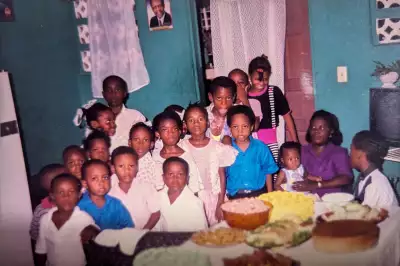
I’m really grateful I got to grow up in Haiti. Those are some of my fondest memories.
My vision of Haiti’s future is one where children get to experience the one that I grew up in—not the one that I had to escape from.
Haitian identity is deeply complex, shaped by a rich tapestry of ethnicity, culture, language, and history—each layered with profound historical significance. I see Haitian identity as inherently cosmopolitan.
We inherited this land from Native Americans, who were tragically wiped out by European colonizers. The first true Haitians, at the moment of independence, were Africans brought from various regions of the continent. In a powerful act of self-definition, they altered the French flag by removing the white section and stitching together the red and blue. Haitian Creole itself is a fusion of French, African languages, and Indigenous dialects—a living testament to our resilience and adaptability, built from diverse and often fragmented elements.
As a member of the diaspora, the question of identity becomes even more nuanced. I often find myself creating a culture within a culture that seeks to estrange me. As an artist, I’ve learned to embrace my challenges and the many influences surrounding me, and to make something meaningful out of them. How quintessentially Haitian.
Frantz Lexy ( b. 1991, Port-au-Prince, Haiti; lives in Boston, Massachusetts) is a self-taught artist whose vibrant and eclectic paintings are driven by a spirit of experimentation. His work exists at the intersection of the personal, the political, and the spiritual, offering a deep exploration of identity, belonging, humanity’s relationship with nature, and its evolving connection to technology. Using a variety of visual mediums, Lexy delves into these themes with a keen interest in how paradoxical imagery generates tension, prompting viewers to reflect on their immediate emotional and intellectual responses.