Bossou
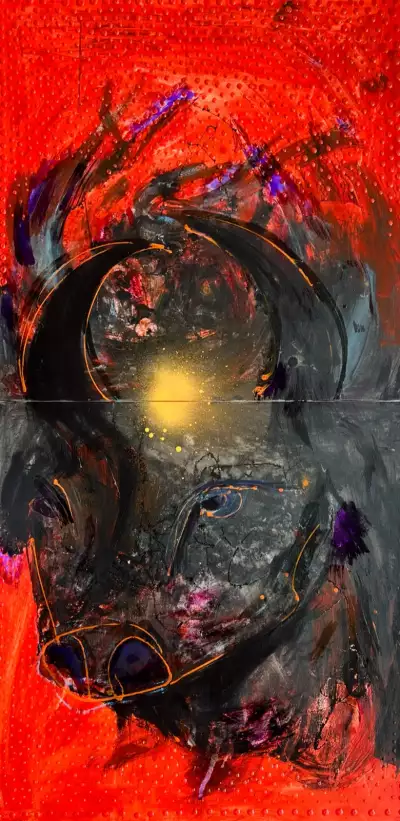
BASTIK, Bossou, 2024, Acrylic on canvas
Synchronicity and Spiralism
On July 30th, 2024, I was on the bus, scrolling on my phone, when I stumbled upon the news that Israel had bombed the suburbs of Beirut. I found myself overwhelmed with worry and anger as I scrambled to call my partner Rami, whose family lives there. My anger that day wasn’t new, though—it had been simmering for some time, fueled by the destruction of Palestine and the ongoing genocide there. The events in Lebanon reignited that fire within me, compounding my frustration and helplessness, and making me realize that this genocide has become background noise, normalized in this world.
On my way to my studio, I was consumed by these emotions, and as soon as I arrived, I began to paint—not with a goal, but with an urgent need to channel what I was feeling. I painted a diptych that absorbed the chaos of my emotions with every brushstroke: a black stain stretched across a red background, with a glowing yellow light emerging in the space between the two panels. The act was instinctive, almost unconscious. When I got home that day, I looked at the picture I had taken of my chaotic composition and noticed something emerging—a bull.
The next day, I returned to the studio and carved the bull out from the darkness, leaving the yellow light suspended in the middle, glowing like a presence between the two canvases. The painting felt powerful but alien—unlike anything I had created before. Seeking insight, I reached out to my cousin Julie, who researches Haitian culture, history, and Vodou spirituality. I asked her about the significance of bulls in Haitian traditions, and off the top of her head, she shared that bulls are tied to the land and agricultural practices, and that in Vodou, the sacrifice of a bull is reserved for great causes.
That week, she sent me songs about bulls from Haitian artists like RAM, whose lyrics emphasized the bull’s endurance—its refusal to die easily. The symbolism struck me deeply. What was I painting? Was I painting a dying bull? Was I painting defeat?
As Julie continued her research, she connected the bull to Bossou, a lwa in Vodou associated with strength, protection, and the bull. What began as a spontaneous outpouring of emotion started aligning with layers of meaning from Haitian spiritual and cultural traditions. Julie shared a song, "Bossou ki kotew prale," by Samba Nikel. I had never heard of this song or seen its artwork before. But the album cover strikingly resembles my painting.
The connection deepened when I saw the vèvè associated with Bossou. On the geometrical drawing, there is a bull, and on the bull’s head was a star—not just any star, the Star of David. The same star that appears on the Israeli flag. This detail left me speechless. I am still not sure what to think about it. The alignment between my painting, the violent events that propelled it, and the cultural and spiritual elements tied to Bossou felt inexplicable yet undeniable.
Reflecting on this experience, I find myself drawn to Frankétienne’s spiralism, which affirms that chaos is the womb of life and light. The chaos of my emotions, the chaos in Palestine, Beirut, Haiti, and the chaos on my canvas were all part of a larger process of creation. From the dark stain emerged the bull; from anger and worry emerged a sense of protection and endurance.
Bossou’s light was there all along. Before the bull, before the forms emerged, the light had been present in the middle of the two canvases—a quiet, persistent force holding the chaos together.
I do not claim to fully understand what happened. As someone who is not a Vodou practitioner, I approach these connections with deep respect and humility. What I can say is that this was a metaphysical experience for me—a moment where emotions, symbols, and the unseen forces of culture and history intertwined in a way that defies logical explanation.
Today, Bossou’s light illuminates new possibilities of being for me: the refusal to accept defeat, the understanding that defeat is death, and the endurance to find creation amid destruction. While I may not fully grasp the meaning of this experience, I hold the story close, allowing its mystery to live alongside its power.
Frankétienne says: The cosmos is the fundamental matrix of chaos, and chaos is inevitable.
Bossou explores the interplay of memory, communication, and identity as integral forces shaping Haiti’s past and future. Drawing from the rich visual and spiritual cultures of Haiti, the work weaves elements that speak to our capacity for regeneration and transformation. I see the future of Haiti as not just an aspiration but a continuation of the bold spirit that led to its historic revolution—a spiral of resistance and renewal that transcends time and space. It is an invitation to dream collectively, act with intention, and celebrate the intricate cultural connections we share.
Haiti’s future is not separate from its present or its past—it is a living spiral of possibilities, built on the enduring wisdom of its people and their relationship with the land. Through this work, I hope to echo that enduring call for freedom and autonomy while offering a space for reflection, dialogue, and hope.
Bastik (b. 1997, Port-au-Prince, Haiti; lives in Montréal, Québec) is a multidisciplinary artist and mechanical engineer. She began her artistic practice at the age of 4 as a student of Kay Tiga in Port-au-Prince, Haiti. Practicing the “Artistic Rotation” method—freely roaming from ink to paint to clay—blurring the boundaries between mediums quickly became second nature to her. Her work explores themes of connection, identity, and Haitian visual cultures of nature through a multitude of media. She has exhibited at the Montreal Museum of Fine Arts (MBAM), Le Livart, and the Maison de la Culture Claude-Léveillée.